
Front-row seats to orbit: How La Cañada Flintridge watches SpaceX from the driveway
Thursday, Sep 24, 2026, 8:00 AM PDT
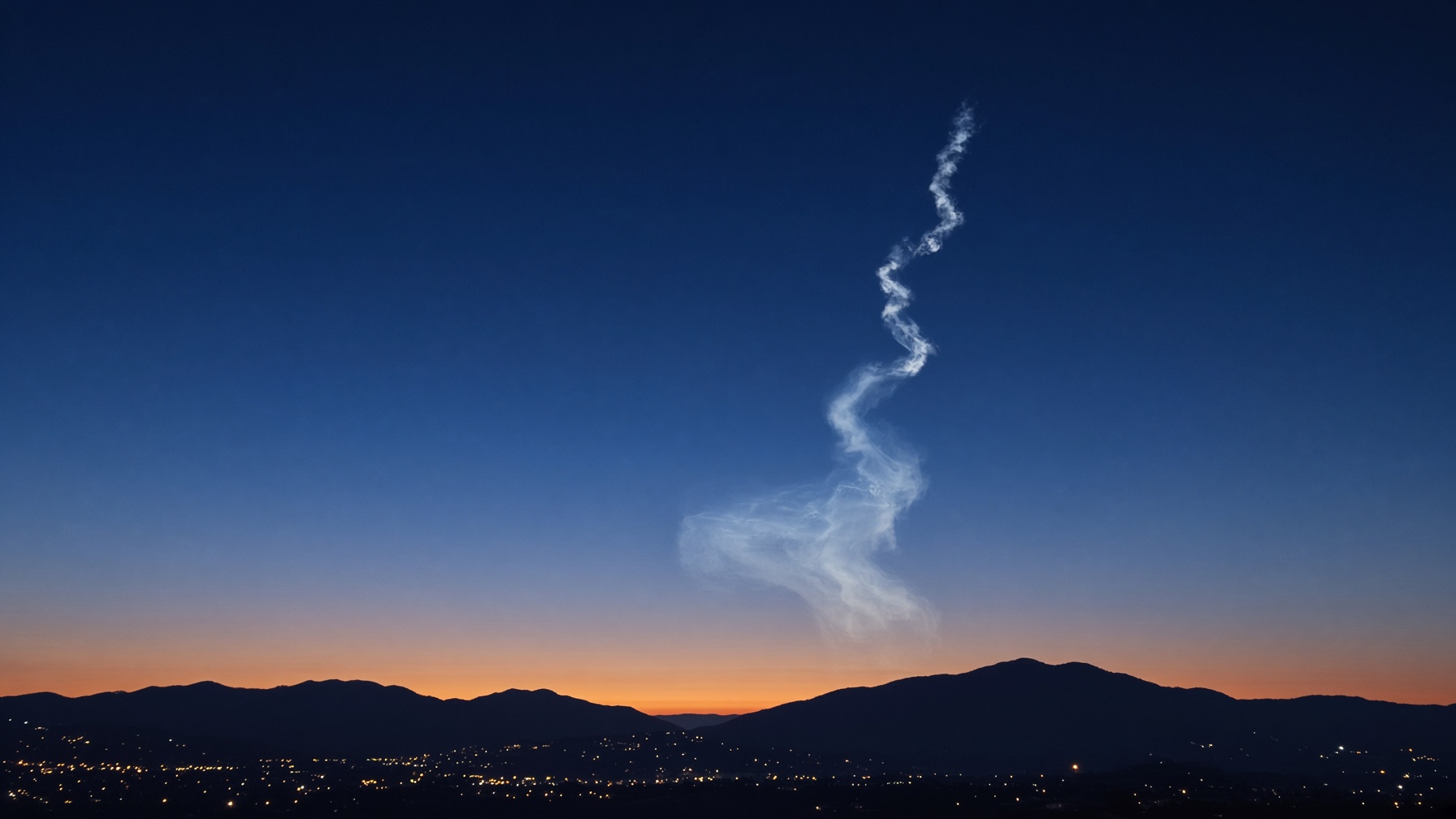
As a resident of La Cañada Flintridge, you already have something most of the country has to book a flight for: front-row access to rocket launches tied to the engineers in your own community. You do not need a badge, a viewing stand, or a trip to Florida. On the right evening, the show starts over the western horizon, climbs through twilight, and turns the sky into a glowing jellyfish while dinner is still on the table.
The rockets themselves lift off about 140 miles up the coast at Vandenberg Space Force Base. Because that pad sits on the Central Coast and many Falcon 9 missions head south over the Pacific, the plume is often visible from the Los Angeles Basin when skies are clear, and the foothills of La Cañada Flintridge sit high enough, and face the right way, to catch it.
The most theatrical nights are twilight launches. The ground is already in shadow. The rocket is still in sunlight. Exhaust expands in the thin upper air and the sun lights it from below, so the plume blooms into a pale, tentacled shape people now call a space jellyfish. Southern California has seen that effect stretch from the coast inland toward the mountains more than once.
You will not see a tiny flame on the pad from Oak Grove Drive. What you get is the high-altitude act: a bright spark rising, a widening veil, sometimes a second-stage burn that hangs like a lantern. West-facing decks, the ridges above town, and even a clear backyard with a view past the Verdugos can be enough. Clouds and marine layer still cancel the night. When they do not, the foothills become a free observatory.
The lab at the end of Oak Grove
That sky show sits next to a quieter fact of local life. NASA’s Jet Propulsion Laboratory is not “near” La Cañada Flintridge. Its street address is 4800 Oak Grove Drive, La Cañada Flintridge. The mailing address still says Pasadena. The campus is in the city’s eastern foothills.
JPL did not design Falcon 9. SpaceX builds those vehicles in Hawthorne and flies them from Vandenberg and Florida. What NASA and JPL did was help make a company like SpaceX possible, and then put some of this valley’s own hardware on those rockets.
In the mid-2000s, NASA’s commercial cargo and later commercial crew programs paid SpaceX to develop Falcon 9 and Dragon when the company was still small. Those fixed-price contracts, plus NASA’s later certification of Crew Dragon, turned a startup into the workhorse that now flies weekly. SpaceX became one of NASA’s largest vendors. The agency still uses Falcon 9 and Falcon Heavy to send science missions into orbit and beyond.
JPL’s piece of that story is the payload. The lab designs and operates NASA’s robotic explorers. Some of those spacecraft now ride SpaceX. SPHEREx, a JPL-managed all-sky infrared survey, lifted off from Vandenberg on a Falcon 9 in March 2025. SWOT, another JPL-linked Earth science mission, flew the same route. Europa Clipper, the largest planetary probe NASA has built, assembled at JPL, left Earth on a Falcon Heavy. The neighborhood that maps Mars and listens to Jupiter also lives under the same western sky that lights up when a reused booster leaves California.
That is the local inheritance: not that every Falcon 9 was welded on Foothill Boulevard, but that the people who send robots across the solar system work here, NASA paid to grow the commercial rockets those robots now fly on, and the launches themselves are frequent enough to become part of the evening weather.
When the jellyfish is coming
Guessing from a calendar is a bad way to plan. The account that exists for this exact problem is Space Jellyfish Alerts on X: https://x.com/spacejellyalert
The feed posts when a launch, often a Vandenberg Starlink flight, has the geometry to produce a sunlit plume for people already in darkness. The same project runs a predictor at https://jellyfish.johnkrausphotos.com/. You drop in a location and get a forecast of whether the jellyfish is likely, how high it may sit, and how the odds change if the window slips. It is a public beta, not a guarantee, but it is built for the question foothill residents actually have: Will I see it from here tonight?
Follow the account. When it flags a California evening window, step outside a few minutes after liftoff and look west to northwest. Phone cameras struggle; your eyes usually do not.
You can grab your spouse, pour a glass of wine, and walk onto the patio like it is just another clear night in the foothills. No bleachers. No two-hour drive to Lompoc. The ridge is already your seat. What you are toasting is not only a private rocket company. It is a town that grew up around one of the country’s great engineering labs, still sends spacecraft into deep space, and now gets a recurring light show when those same commercial rockets climb into the last sunlight of the day. A rocket jellyfish over the San Gabriels is a strange luxury. It is also, for this zip code, a kind of civic fireworks, a reminder that the work done on Oak Grove Drive still reaches the sky, and that the sky, on the right night, reaches back. Celebrate the engineering heritage. Then look up. The light show is unlike any other, and it starts at the doorstep.
Related articles


lacanada.us