
A Short History of La Cañada Flintridge
Friday, Oct 6, 2023, 8:00 AM PDT
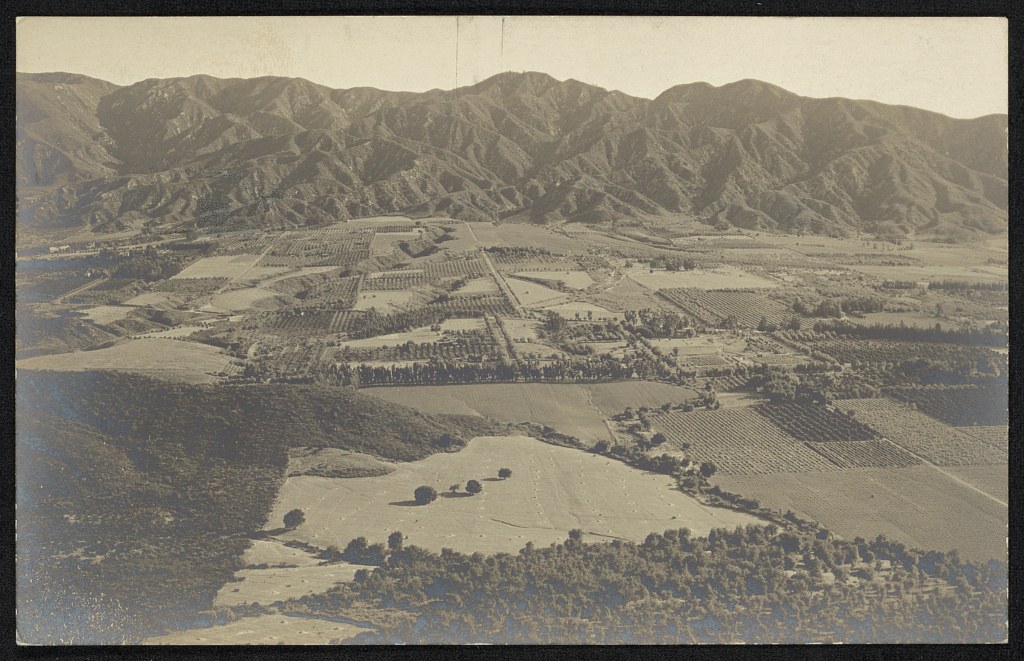
La Cañada Valley from Somes Peak, 1907. An early view across the largely undeveloped La Cañada Valley, decades before incorporation of the modern city.
Credit: Library of Congress, Prints and Photographs Division. Originally published by Frashers Foto, 1907. Public domain in the United States.
La Cañada Flintridge may feel like a quiet foothill suburb today, but its history stretches back centuries, from Indigenous people traveling through the San Gabriel foothills, to Spanish and Mexican ranchos, to orchards, estates, scientists, and generations of families who have made this valley home.
Before La Cañada
Long before there were roads, schools, or neighborhoods here, the foothills of the San Gabriel Mountains were part of the homeland of Indigenous peoples generally known today as the Tongva, or Gabrielino.
The La Cañada valley itself may not have supported a large permanent village because reliable year-round water was limited, but Indigenous people almost certainly traveled through and used the area for hunting, gathering acorns and other plants, and moving between settlements throughout the Los Angeles basin and nearby foothills. The landscape they knew would have looked very different from the community we see today: oak woodlands, chaparral, seasonal streams, and open foothills stretching toward the San Gabriel Mountains.
Rancho La Cañada
Spanish settlement reshaped the region beginning in the late 1700s. In 1781, José María Verdugo, a Spanish soldier associated with Mission San Gabriel, received permission to graze livestock across a huge tract of land between the Los Angeles River and Arroyo Seco known as Rancho San Rafael.
The Verdugo family became one of the most prominent early landholding families in the area, controlling territory that included much of present-day Glendale, La Crescenta, and the surrounding foothills. During the Mexican period, the La Cañada valley was separated from those larger holdings. In 1843, the land was granted as Rancho La Cañada to Los Angeles educator Ignacio Coronel.
The rancho changed hands several times before Dr. Jacob Lanterman and Colonel Adolphus Williams purchased the remaining 5,832 acres in 1876. The Lanterman family became especially important in the growth of the community. Their historic residence survives today as the Lanterman House, one of La Cañada Flintridge's best-known local landmarks.
La Cañada and Flintridge Were Once Two Different Communities
One of the most interesting things about the city's history is right there in the name. La Cañada and Flintridge developed separately.
La Cañada grew largely from ranches, orchards, farms, and residential development across the valley floor. For decades, the area retained a semi-rural feel, with large lots, agricultural land, and relatively little commercial development.
Flintridge had a different beginning. In the early 20th century, former U.S. Senator Frank P. Flint acquired and subdivided roughly 1,700 acres south of Foothill Boulevard in the San Rafael Hills. The new residential area became known as Flintridge, taking its name from Flint himself.
Flintridge developed more as an estate community, with larger lots and hillside homes, and over time it developed its own identity separate from La Cañada. The two communities did not immediately agree that they should become one city. Several incorporation efforts failed, and at various times there was discussion of Flintridge forming its own municipality.
By the 1970s, however, residents increasingly wanted more local control over zoning, development, land use, and municipal services. There were also concerns that neighboring Pasadena or Glendale might eventually annex portions of the area. In 1976, voters approved incorporation, officially creating the City of La Cañada Flintridge. The name (notably without a hyphen) joined two historically distinct communities into one city.
The Creation of the La Cañada Unified School District
Schools have played an enormous role in shaping modern La Cañada Flintridge. For many years, the community maintained local elementary schools, while older students attended schools in surrounding districts. Beginning around 1920, many local students attended John Muir High School in Pasadena.
As La Cañada and Flintridge grew rapidly after World War II, residents increasingly wanted a complete local school system serving students from kindergarten through high school. In 1960, local voters approved the creation of their own K–12 school district by nearly a two-to-one margin. The La Cañada Unified School District began operating in 1961, and La Cañada High School opened in 1963.
That decision would become one of the most important in the community's history. Over the following decades, La Cañada's public schools developed a strong academic reputation, and the school district became closely tied to the identity of the city itself. Today, the quality of the schools remains one of the biggest reasons families choose to move to La Cañada Flintridge.
A Community of Scientists, Families, and Longtime Residents
Modern La Cañada Flintridge is an unusual mix of old and new. Some families have lived here for generations, with roots stretching back to the days when much of the valley was covered by orchards, ranches, and undeveloped land.
The community has also long been closely connected to NASA's Jet Propulsion Laboratory, located immediately next door. For decades, JPL scientists, engineers, and their families have made La Cañada home, and many retired JPL employees still live throughout the community today. At the same time, younger families continue to move here in search of highly regarded public schools, quiet residential neighborhoods, proximity to Los Angeles, and immediate access to the San Gabriel Mountains.
That combination gives La Cañada Flintridge much of its character: a foothill town with deep roots, a strong scientific and professional community, excellent schools, and families who often stay for decades.
La Cañada Flintridge by the Numbers
Recent public data gives a snapshot of the community today:
| Metric | Approximate Figure |
|---|---|
| Population | About 19,500 |
| 2020 Census population | 20,573 |
| Households | More than 6,300 |
| Median household income | More than $240,000 |
| Per-capita income | About $105,000 |
| Residents under age 18 | About 27% |
| Residents age 65 or older | About 20% |
| Poverty rate | About 3.5% |
| Land area | About 8.6 square miles |
| Population density | About 2,300 people per square mile |
Perhaps the most interesting statistic is how little La Cañada Flintridge has grown in population. The community had roughly 21,000 residents around the time it incorporated in 1976, and today it has fewer than 20,000.
While much of Southern California became dramatically denser over the past half-century, La Cañada Flintridge has largely remained what its residents intended it to be: a low-density residential community of single-family homes, limited commercial development, strong public schools, and easy access to the foothills. That continuity may be one of the most defining features of La Cañada Flintridge, and one of the reasons generations of residents continue to call it home.
Sources
Related articles


lacanada.us editorial staff