
Why Some La Cañada Homeowners Are Seeing a Surprising Drop in Their Property Tax Bills
Friday, Aug 28, 2026, 8:00 AM PDT
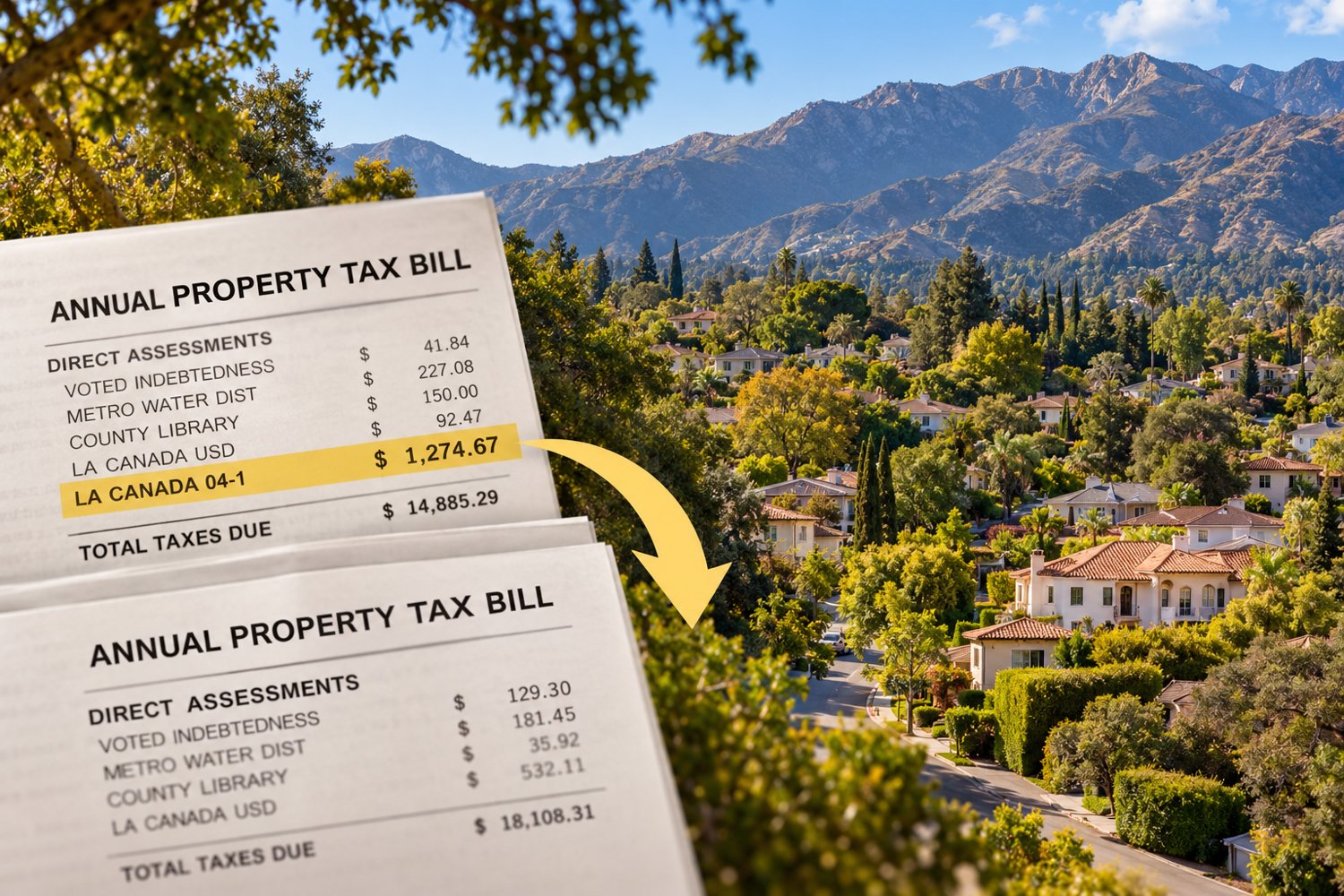
A special assessment dating back to the 1990s has been disappearing from property tax bills across parts of La Cañada Flintridge, potentially saving some homeowners more than $1,000 annually. The explanation involves one of the largest public works projects in the city's history, a decades-long debate over septic tanks, and a major infrastructure investment that divided the community geographically.
When La Cañada Ran on Septic Tanks
For much of its history, La Cañada Flintridge operated without a comprehensive public sewer system. As recently as 1993, approximately 90% of the city's 6,700 households relied on individual septic systems rather than municipal sewers. Wastewater from homes was treated and disposed of underground through septic tanks and leach fields.
Although septic systems can operate effectively when properly designed and maintained, they become increasingly problematic as communities grow and systems age. Failing septic tanks can contaminate groundwater, create unpleasant odors, and require expensive repairs or replacement. By the early 1990s, city officials were increasingly concerned about the long-term viability of depending on thousands of individual septic systems.
A 1992 report from the Los Angeles County Sanitation Districts raised concerns about the city's unusually extensive reliance on septic systems for a developed community. The city began pursuing a comprehensive sewer construction program that would connect residential neighborhoods to regional wastewater collection and treatment infrastructure. The undertaking would require installing miles of underground sewer pipes, connecting neighborhoods to existing regional facilities, and developing a financing mechanism that would make the project affordable.
Source: Los Angeles Times, July 29, 1993
A Massive Underground Construction Project
Beginning in 1998, La Cañada Flintridge established a series of special assessment districts to finance construction of its public sewer system. Three major projects were completed over the following decade:
| Assessment District | Established | Construction Completed |
|---|---|---|
| 98-1 | 1998 | 1999 |
| 02-1 | 2002 | 2005 |
| 04-1 | 2004 | 2008 |
These projects primarily served residential neighborhoods north of Foothill Boulevard. Construction involved excavating streets, installing underground sewer mains, and creating connections to larger wastewater collection systems.
The city's topography helped make conventional gravity-fed sewers practical in many northern neighborhoods. These systems use the natural slope of underground pipes to transport wastewater, reducing the need for mechanical pumping equipment. Depending on their location, the new sewer networks ultimately connected to facilities operated by the Los Angeles County Sanitation Districts or, through the Crescenta Valley Water District, the City of Los Angeles.
By 2008, much of northern La Cañada Flintridge had gained access to public sewer service.
Source: City of La Cañada Flintridge General Plan, Chapter 6
Who Paid for All Those Sewers?
The city faced a significant challenge: installing an entirely new sewer network was enormously expensive. Rather than funding construction entirely through the city's general operating budget, La Cañada Flintridge used special assessment districts. Under this arrangement, properties receiving the benefit of new sewer infrastructure were assigned a portion of the construction costs.
Homeowners could generally pay their assigned assessment upfront or finance the obligation over an extended period. The city arranged financing through a combination of bonds and low-interest loans from the State of California, allowing construction to proceed while property owners repaid their assessments over time.
For example, Sewer Assessment District 04-1 involved approximately $18.9 million in bonds issued in 2004. These were subsequently refinanced in part through a California state loan that ultimately totaled approximately $26.9 million. The state financing carried favorable interest terms, helping spread the substantial construction costs over approximately two decades.
For homeowners who elected to finance their assessments, the annual payments were collected directly through Los Angeles County property tax bills. These charges appeared in the Direct Assessments section, separate from ordinary property taxes.
Unlike the standard property tax levy, which is based on a property's assessed value, these sewer assessments reflected the cost of infrastructure improvements benefiting particular properties. Depending on the assessment district and property characteristics, the annual charges could be substantial. And unlike ordinary property taxes, these construction assessments were intended to end once the applicable payment obligations had been satisfied.
Source: City of La Cañada Flintridge, Annual Financial Reports
Why Didn't the City Install Sewers South of Foothill Boulevard?
One of the most interesting chapters in La Cañada Flintridge's sewer history concerns the neighborhoods that never received public sewer service. Although much of the northern half of the city was connected to the new sewer network, large portions of Flintridge, south of Foothill Boulevard, continued relying on septic tanks.
The omission was not simply an oversight. The city actively pursued extending sewers into Flintridge, but encountered two significant obstacles: difficult geology and homeowner opposition to the enormous cost.
Unlike many of the neighborhoods north of Foothill Boulevard, parts of Flintridge have rocky terrain and relatively shallow bedrock. Installing conventional gravity-fed sewer lines in these areas would require extensive excavation through rock, dramatically increasing construction costs. City engineers explored alternatives, eventually proposing a low-pressure sewer system.
Unlike traditional gravity sewers, low-pressure systems use individual pumps to move wastewater through smaller pipes. The approach could reduce excavation costs, but it introduced additional equipment, electricity consumption, and maintenance responsibilities for property owners.
The $40 Million Proposal That Residents Rejected
In 2009, the city proposed a low-pressure sewer project covering approximately 680 properties in several neighborhoods south of Foothill Boulevard. The estimated cost was nearly $40 million.
Depending on property size, location, and street frontage, homeowners faced proposed assessments ranging from approximately $40,000 to $73,000 per property. Those who financed their assessments over 20 to 30 years could have faced annual payments ranging from approximately $3,000 to more than $6,500. Additional maintenance costs for individual pumping equipment were also anticipated.
The proposal arrived during the aftermath of the 2008 financial crisis, when many homeowners were reluctant to assume substantial new financial obligations. Although an earlier survey indicated interest in studying the project, residents ultimately rejected the proposed assessment district in October 2009.
The defeat effectively halted the city's plans for a comprehensive sewer expansion into southern Flintridge. Consequently, much of the area south of Foothill Boulevard continues to rely on individual septic systems today.
The dividing line is not absolute: some properties south of Foothill have sewer connections, while some north of Foothill remain unconnected. Nevertheless, the street remains a useful geographic reference for understanding the city's sewer development.
Sources: - La Cañada Valley Sun, September 24, 2009 - La Cañada Valley Sun, October 8, 2009
Two Decades Later, the Bills Are Finally Ending
For homeowners who participated in the original sewer construction assessment districts, the financing arrangements meant paying annual assessments for many years after the underground construction work was completed.
Now, those obligations are reaching their conclusion. According to the city's published financial records, the underlying loans for two major districts have already been repaid:
| Sewer District | Financing Status |
|---|---|
| 98-1 | Loan fully repaid in fiscal year 2020–2021 |
| 02-1 | Loan fully repaid in fiscal year 2024–2025 |
| 04-1 | Final loan repayment scheduled for fiscal year 2027–2028 |
Importantly, the City's adopted 2025–2026 budget explicitly confirms that fiscal year 2023–2024 was the final year in which sewer construction assessment fees were collected for District 04-1.
Although the city's underlying loan for that district continues through 2028, the assessment collections ended earlier, with accumulated funds available to cover the remaining obligations.
The retirement of the underlying loans does not necessarily establish when assessments ended for every property in the other districts. Individual homeowners should verify the applicable assessment and collection history.
Source: City of La Cañada Flintridge, Adopted FY 2025–2026 Budget
How Much Could Homeowners Be Saving?
The financial impact can be considerable.
For example, an actual La Cañada Flintridge property tax statement from fiscal year 2013–2014 included a $1,274.67 annual assessment identified as `LA CANADA 04-1`. A comparison with the same property's 2026–2027 tax statement confirms that the assessment is no longer present.
While the property's overall tax bill has increased over the intervening years because of changes in assessed value and other taxes, the disappearance of that particular assessment represents the elimination of a substantial annual expense. The amount saved when the assessment ended depends on the property's final annual charge, which may differ from its historical assessment.
For homeowners who have lived in La Cañada Flintridge for many years, this change may have occurred without much notice. Property tax statements contain numerous individual charges, and residents may not immediately recognize when one disappears.
How to Check Your Property Tax Bill
Homeowners in neighborhoods north of Foothill Boulevard who participated in one of the original sewer assessment districts should compare an older property tax statement with their most recent bill.
Look under the Direct Assessments section for descriptions identifying one of the city's sewer assessment districts, including `LA CANADA 04-1`. The precise descriptions for the other districts should be verified against County records.
If one of these charges appeared on an older bill but is absent from a recent statement, the homeowner may already be benefiting from the retirement of a sewer construction assessment. For District 04-1, the city has confirmed that assessment collections ended after fiscal year 2023–2024.
Residents should also understand that sewer construction assessments are different from ongoing charges for sewer maintenance or wastewater services, which may continue after construction financing has been retired.
Previous and current property tax information can be accessed through the Los Angeles County Property Tax Portal.
For questions about individual sewer assessments, homeowners can contact the assessment administrator at (866) 807-6864, the telephone number listed for District 04-1 on a historical Los Angeles County property tax bill. Residents may also contact the City of La Cañada Flintridge Finance Department at (818) 790-8880.
A 30-Year Investment Finally Pays Off
Nearly three decades after La Cañada Flintridge began its ambitious sewer construction program, the financial obligations associated with that investment are coming to an end.
The projects fundamentally changed how wastewater is managed across much of the city, replacing thousands of individual septic systems with modern underground infrastructure. The history also explains why La Cañada Flintridge remains divided between neighborhoods served by public sewers and those still relying on septic tanks.
For residents wondering why their property tax statements suddenly look a little different, the explanation may be hiding in a single missing line. That special assessment disappearing from your property tax bill may be the final chapter of La Cañada Flintridge's decades-long sewer construction project. For some homeowners, the disappearance of that charge represents more than $1,000 in annual property tax bill savings, an unexpected financial benefit from an infrastructure investment made a generation ago.
Sources: City of La Cañada Flintridge General Plan; City Adopted Budgets and Annual Comprehensive Financial Reports; Los Angeles County Auditor-Controller; Los Angeles Times; La Cañada Valley Sun.
Related articles



lacanada.us editorial staff